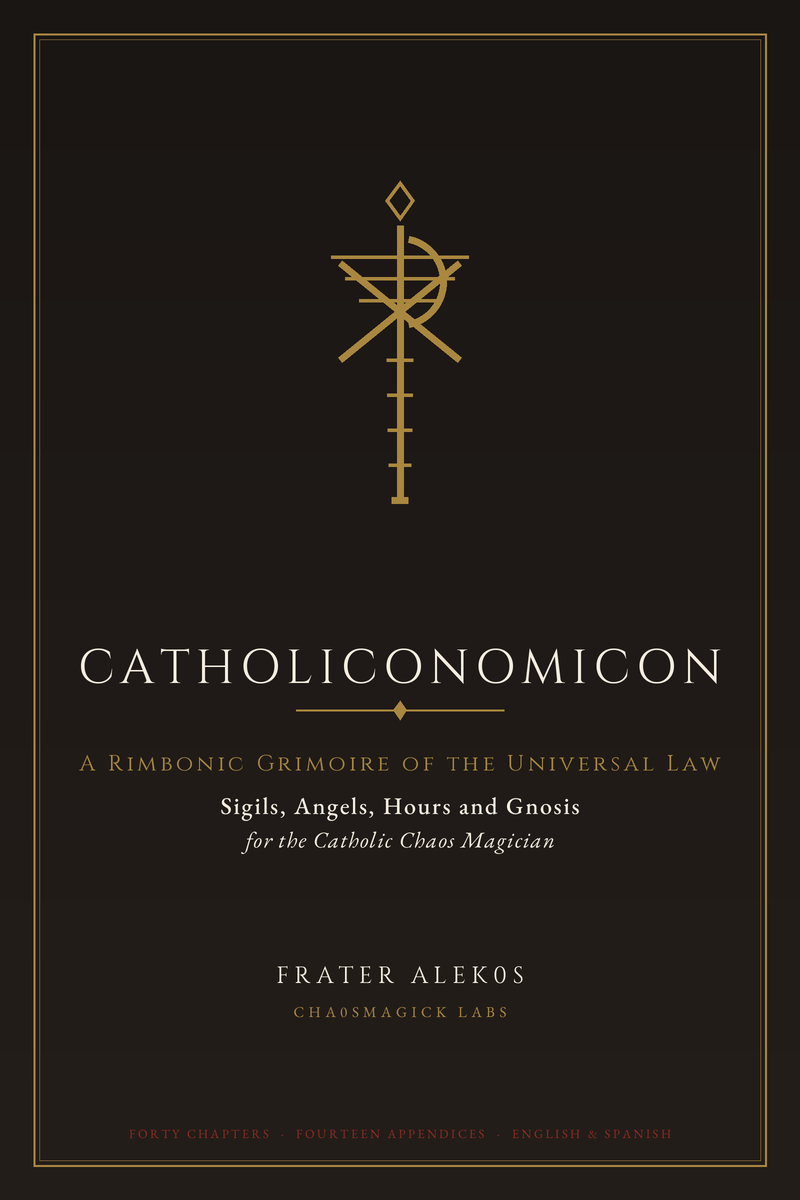
There is a story about Austin Osman Spare that gets told badly. The usual version says that chaos magick was invented by a man who rejected ritual. The historical record says something more interesting: Spare was raised in Montserrat, in a household where Catholic ritual was not decoration but instruction, and he knew the form of the Exorcism before he knew most of what the twentieth century would later call magic.
What Spare did with that inheritance was not to throw it away. He extracted the mechanism and rebuilt it as a technology. That is the whole of his original contribution, and it is why the two traditions fit together better than either side usually admits.
Where chaos magick sits in the library
Spare was not an esotericist
Spare's formation was unusual. He trained as a painter in the late nineteenth century, and his practice comes out of artistic technique as much as out of occult tradition: the deliberate reproduction of a state until the state becomes available at will. That is closer to a skill than to a creed, and it explains why his method asks so little in the way of belief.
He also wrote under the name of A. O. Spare in journals and pamphlets, and his work circulated widely in an avant-garde context. Susan Sherwin's history of Western esotericism places him at a genuine junction point, between late nineteenth century ceremonial magic and the counterculture that would claim him in the 1970s.
What Carroll kept and what he changed
Peter Carroll picked up Spare's method in 1972 and made it portable. Liber Null has three sections: a short course of light and dark exercises, a chapter on the four elements, and a set of instructions for a single ritual of self-intent. What Carroll added was a psychological frame. Carroll had a PhD in psychology, and in The Octopus and the Elephant he argued explicitly that the point of the ritual is to change the practitioner, not the world.
That single move is what separates chaos magick from almost everything before it. A traditional operation asks for an effect in the world. Carroll's instruction is that you perform the operation on yourself, and the world is downstream of that.
What the Roman Rite actually gives you
Form as a container
Catholic ritual is unusually formal, and beginners often read that formality as bureaucracy. It is closer to a container. The fixed words exist so that attention does not have to be spent generating them. If you are holding an intention in mind, you are not also trying to be eloquent.
The preparatory rite of the Roman Rite makes this explicit. The priest or minister traces the sign of the cross with a stole, sprinkles with water, and recites an antiphon — Ecce aqua, "Behold the water" — while holding a branch of willow or laurel. The symbolism is transparent: this is a boundary marked before anything happens inside it.
The Ephpheta and the language of binding
Standing outside a house or a person, the rite addresses the place as a thou, and asks that the place be bound. Nec plus mea pecata tedere potest: "let not my sins hurt you." It is a ritual vocabulary of binding and protection built around a very specific claim — that the minister is not acting for themselves.
Read alongside Spare, the resemblance is not superficial. Both work by establishing a boundary, then acting inside it, then closing it. One uses the person as the agent, the other uses the office.
Put this into practice
Start with the exercise, not the rite
If you take one thing from Carroll, take the first exercise of Liber Null: sit, close your eyes, and hold a light in front of the closed eyes until you can do it at will, then hold a darkness, then hold the light again. It looks trivial. It is the foundation of everything else, because it separates intention from daydream.
Do it daily for two weeks before you attempt anything else. Spare's own warning was that the capacity to hold a state is the instrument, and it degrades without use like any other capacity.
A worked combination
Having marked a boundary the way the Ephpheta does — naming it, walking it, and stating what you are and are not doing there — perform Carroll's ritual inside it, substituting your own name and sigil. The structure is honest because neither tradition is being asked to validate the other. You are borrowing a container and a technique, and you are the one who knows what the operation is for.
Keep a record. Write down what you did, what you expected, and what actually followed. Do not write down what you hoped. The distinction matters more than it sounds, because a practitioner who confuses the two will eventually persuade themselves of anything.
Where the two traditions disagree, do not resolve it
The honest position is that Spare's method assumes you are the source of the intention, and Catholic ritual assumes you are not. Both are internally consistent. Trying to prove one from the other is the fastest route to losing both. Keep them as separate registers, and be explicit with yourself about which one you are speaking from at any given moment.
References
- Catholic Church. Roman Rite, section "Preparation for the Renunciation of Satan and Reparation for Sin".
- Catholic Church. Catechism of the Catholic Church, 2nd ed., Libreria Editrice Vaticana.
- Jung, C. G. (1951). Aion: Researches into the Phenomenology of the Self. Princeton University Press.
- Sherwin, Susan (2010). Western Esotericism and the Making of the Modern World. Oxford University Press.
- Klaniczay, Gábor (2010). Ritual and Belief in Byzantine and Western Magic. Brepols.
- Spare, Austin Osman (1997). Austin Osman Spare: The Golden Bough and Other Writings. Kegan Paul International.
- Carroll, Peter (2004). Liber Null and Psychonaut. Hermetic Press / Phoenix.
- Carroll, Peter (2003). The Octopus and the Elephant: A Study in Comparative Occultism. Pentacle Books.
- Lachman, Gary (2007). The Culture of New Age. Watkins Media.
- Wilson, Robert Anton (1996). Prometheus Rising. IlHP Books.
- Anonymous (1604). The Book of the Law. Skelton Press / F. T. clandestine printings.