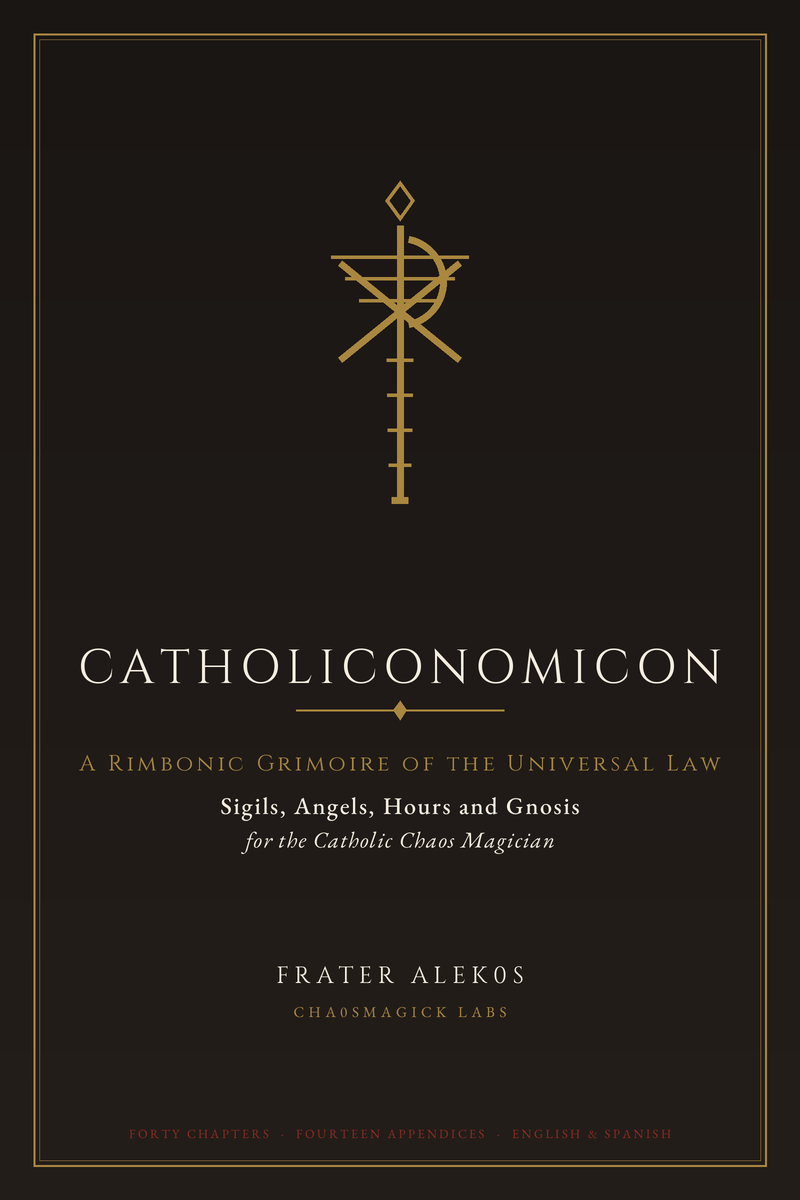
Almost every sigil in circulation was made from words. The claim underneath the practice is that a diagram which no longer states the intent aloud, on the page, in front of another person, is a different kind of object — not a secret written down badly, but a compressed instruction.
Where sigil work sits in the library
Two historical streams
Sigil work as most people encounter it comes from the twentieth-century Western esoteric revival, drawing on the Golden Dawn, on Eli's Promise Land, on the sigil work described by Austin and D.T. Suzuki, and on the general practice of substituting a glyph for a name. Peter Carroll made it a standard part of a light ritual in Liber Null, which is where most chaos practitioners meet it.
A second stream comes out of alchemy and Kabbalah, where a signature was also a contract and a formula was also a seal. Gábor Klaniczay's work on medieval and Byzantine magic is useful here because it shows how consistently ritual manuals present binding images as legal instruments rather than as magic.
Reduction is an act of compression
The mechanics are simple. Write the statement of intent in capitals. Reduce by removing consecutive pairs of the same character until none remain. Then reduce each remaining character to its simplest form. What is left is a glyph that uses a small alphabet and preserves the order of the original words.
Two things follow. First, the method is deterministic: the same statement always yields the same glyph, which is what makes it worth recording. Second, and less often noticed, the method preserves sequence. Any permutation of the words gives a different glyph.
Catholic symbols in this framework
What makes a symbol sacramental
In Catholic theology a sacrament is an outward sign that effects grace. The Catechism describes it as a sign instituted by Christ to give grace, and the form is fixed by the rite rather than left to the minister. That last clause is the important one for this discussion: the symbol is bound to its form.
So a cross used liturgically, a host, a censer, keys, a censer, oil, water, ash — these are not a kit of shapes. Each one is attached to a specific rite, and the attachment is the whole of its meaning. Take one out of that rite and you have removed what was doing the work.
The correspondences problem, stated honestly
The usual pagan-magic move is to build a table: this saint, that planet, this number. Where does it come from? Not from scripture. Medieval and early modern correspondences drew on the natural magic of the period — the properties of stones, the doctrine of signatures, planetary hours, and the descriptions of saints in the Legenda Aurea and similar compilations.
This means a saint correspondence table is a work of historical construction, not of doctrine. That is not a reason to avoid one. It is a reason to build it consciously and cite where the attributions come from, rather than presenting it as settled.
Borrowing the sign, keeping the constraint
My own preference, and the one the Catholiconomicon develops at length, is to keep the constraint attached. Use the cross as a cross, the host as the host, and let the sigil carry the full weight of what that object is for in the tradition. You will get a more constrained practice, and the constraint is what keeps the symbol from becoming decoration.
Put this into practice
A reduction you can repeat
Choose a short statement of intent in your own words. Reduce it in capitals by the pair-removal method, then reduce each character. Draw the result. Write the statement, the reduction steps and the date on the back. This is not mysticism; it is reproducibility, and it is what makes the practice honest.
One material, one constraint
Choose a single medium — ink on paper is fine — and do not change it while you are working. If the tradition you are working inside specifies a material for a given purpose, follow that specification, because the constraint is doing part of the work.
Activate by use
Spare's position was that the sigil is finished by the act of carrying it. Carroll's is that the ritual is performed and then the sigil is carried. Either way, activation is not a separate magical operation with its own incantation. It is the moment the sigil enters the situation it was made for, and it works as well in a folded piece of paper as in a lock of hair.
Keep a log. Every sigil, the statement, the date, and what happened afterward. Over a year you will have more data than intuition, and the data is what tells you whether your method is doing anything.
References
- Catholic Church. Roman Rite, section "Preparation for the Renunciation of Satan and Reparation for Sin".
- Catholic Church. Catechism of the Catholic Church, 2nd ed., Libreria Editrice Vaticana.
- Jung, C. G. (1951). Aion: Researches into the Phenomenology of the Self. Princeton University Press.
- Sherwin, Susan (2010). Western Esotericism and the Making of the Modern World. Oxford University Press.
- Klaniczay, Gábor (2010). Ritual and Belief in Byzantine and Western Magic. Brepols.
- Spare, Austin Osman (1997). Austin Osman Spare: The Golden Bough and Other Writings. Kegan Paul International.
- Carroll, Peter (2004). Liber Null and Psychonaut. Hermetic Press / Phoenix.
- Carroll, Peter (2003). The Octopus and the Elephant: A Study in Comparative Occultism. Pentacle Books.
- Lachman, Gary (2007). The Culture of New Age. Watkins Media.
- Wilson, Robert Anton (1996). Prometheus Rising. IlHP Books.
- Anonymous (1604). The Book of the Law. Skelton Press / F. T. clandestine printings.